
The Fab 5 – A Journey Back into Woodworking
By Sean Cooper
July 6, 2024
After months of moving and setting up my shop in my two-car garage, I’m finally back to doing what I love–creating end grain cutting boards. This time, I embarked on an ambitious project, which I’ve playfully dubbed the Fab 5 (though I’m not sure I’ll market them this way). These five boards represent not just the work I’ve done recently, but also a return to the creative, hands-on process of building something from nothing. What makes these boards particularly special is that many of them were made from leftover offcuts from previous projects–scrap wood that was far too beautiful to discard. Instead of burning or discarding the wood, I reimagined it and gave it new life.
A Fresh Start in My New Shop
Before diving into the process, I have to mention how much it means to be back in a functioning woodshop. Moving my equipment, setting up the workspace, and getting the flow right has been no small feat, but it’s been worth every hour. There’s something about walking into a shop full of possibilities and raw materials just waiting to be transformed into something useful, something beautiful.
Once my garage was organized and ready to go, I began working with various offcuts I had saved from previous projects. These pieces, while often difficult to work with due to differences in thickness, length, and color, were too valuable to toss. Each offcut had its own character, and I knew I could find a way to turn them into something special.
The Fab 5: Where Offcuts Become Art
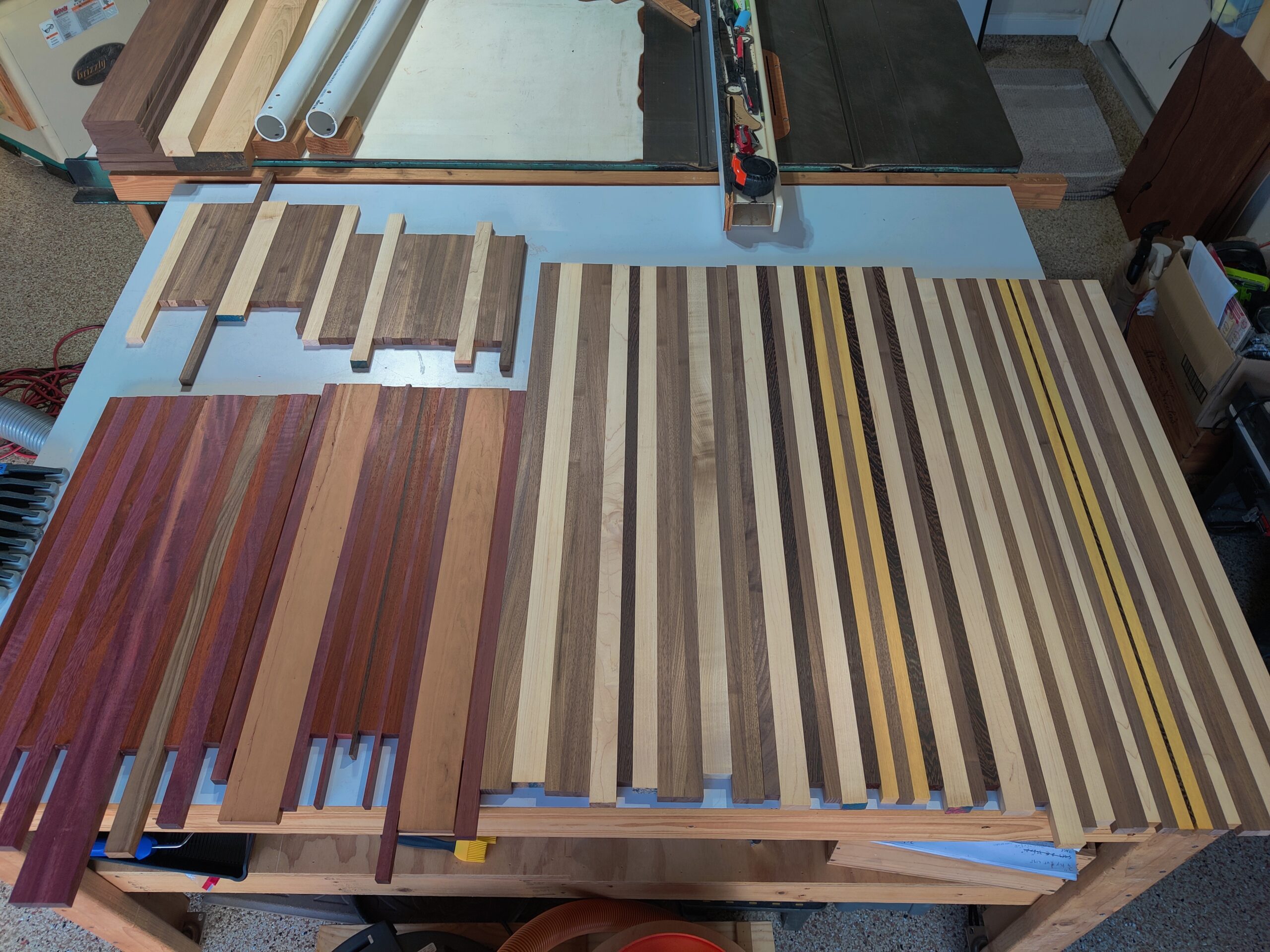
In the image above, you’ll see seven panels, each with a unique pattern made from those offcuts. These panels formed the foundation for the Fab 5 boards, each with its own story to tell.
• The Short Panels: The first two shorter panels are made from strips of hard maple and black walnut, arranged in two different patterns. These panels made use of some shorter pieces I just had to get into a board or two.
• The Purple Panels: Below those, you’ll see two longer panels. One is dominated by purpleheart, accented by strips of padauk, while the other features purpleheart paired with wide strips of cherry, along with alternating strips of padauk and purpleheart, and a thin strip of wenge right at the center.
• The Three Symmetrical Panels: These three longer panels are where things get really interesting. Symmetry is a key feature in my design process, and they were the most fun to conceptualize knowing I would be alternating them in every board that would eventually come.
- One panel has alternating strips of black walnut and hard maple, with a single strip of wenge running down the center.
- Another has an intricate mix of black walnut, hard maple, and wenge, with a striking strip of yellowheart adding contrast and a bold center strip of black walnut.
- The third panel plays with the contrast between hard maple, black walnut, and yellowheart, with a delicate strip of wenge to anchor the center.
These panels were cut into strips and formed the basis for five unique cutting boards. It was during this process that I was able to segue from visualizing how these “scraps” could work into a board to physically manipulating the patterns and manifesting artistic end grain boards that resonated with me.
The Creative Process in Action
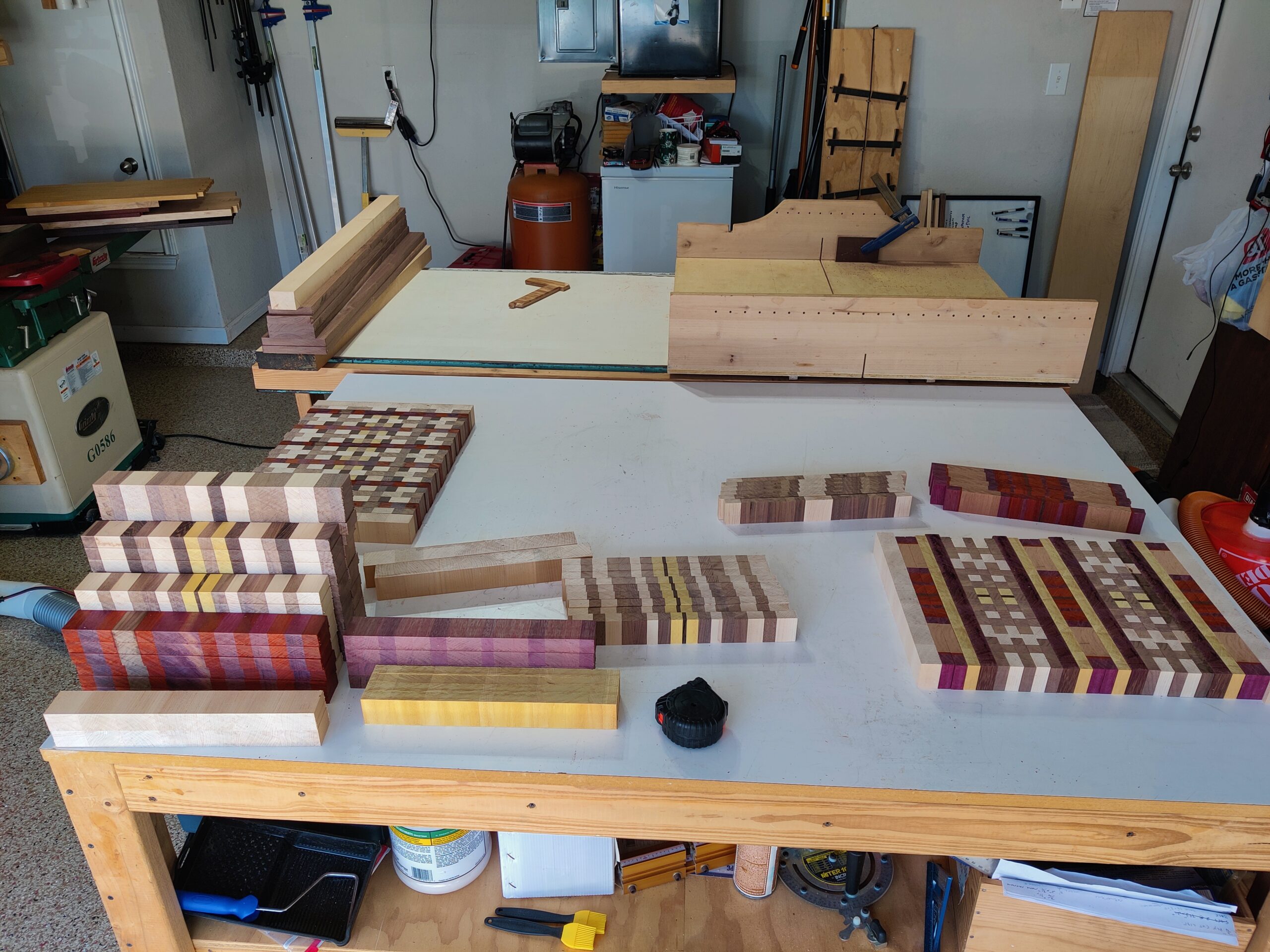
In this second image, you’ll see stacks of board panels that I’ve crosscut into strips. These strips are the foundation of my designs, and while I had the layouts for two boards finished at this point, the creative process was still very much ongoing. Each strip offered a possibility, and I was carefully experimenting with different combinations, trying to find the right balance between color, grain, and symmetry.
In the background of this image, you’ll catch a glimpse of my shop, including the table saw with my crosscut sled, a stack of black walnut and hard maple, and, off to the left, my jointer and another stack of solid wood panels made from wenge, hard maple, purpleheart, yellowheart, padauk, and black walnut.
This image captures the “in-between” phase of creation. At this stage, the boards are still rough and unglued, but the direction is clear. Even though they’re not finished, the patterns have started to emerge, and I could already tell that these boards were going to be something special.
The Fab 5 in Progress
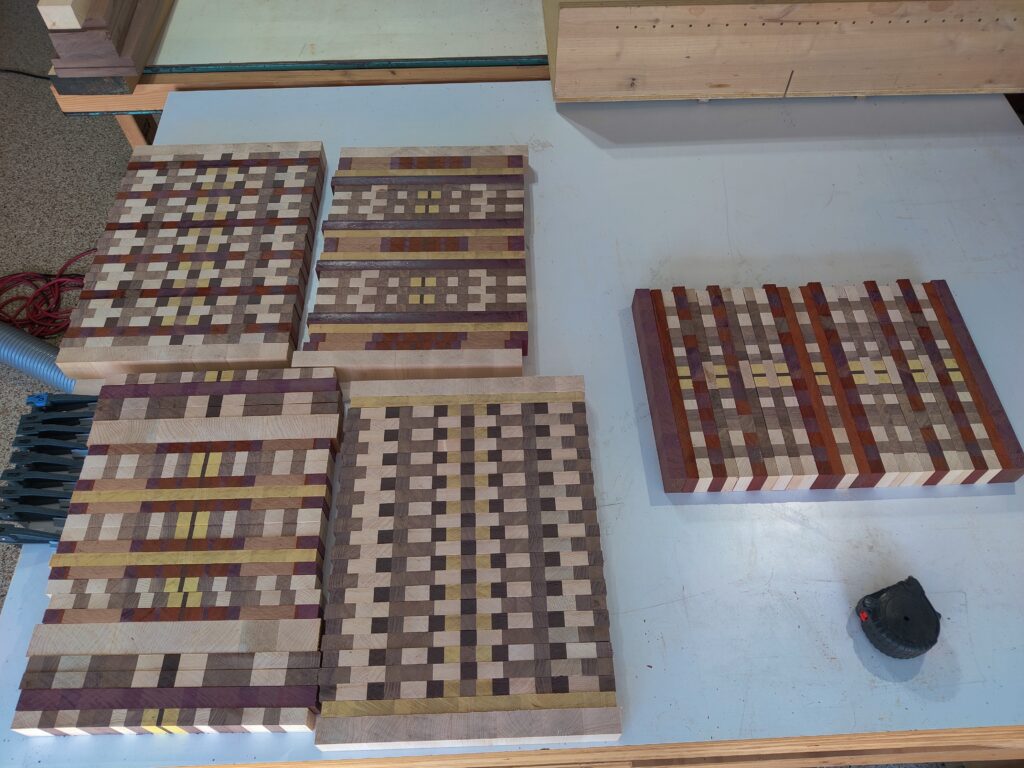
The final image shows the rough designs of the Fab 5 boards. The strips are laid out in their final patterns, but they have yet to be glued, planed, or sanded. A lot of work remained at this point—gluing, flattening, sanding, routing, and, of course, oiling and waxing each board to bring out the richness of the wood. Even so, the designs were clear, and I was excited to see them come together.
Every board in the Fab 5 represents not only the materials I used but also the journey I’ve taken to get back into my woodworking groove. They are a product of my renewed passion, my reimagined shop, and the creative process that comes from working with unique, reclaimed materials.
Looking Ahead
As I write this, the Fab 5 boards are already finished. Each one is unique, and the process of making them was as rewarding as the final product. In a future blog post, I’ll dive into the final stages of finishing these boards and share the completed works.
For now, I hope this post gives you a glimpse into my process and the creative journey I’ve been on in my new shop. The Fab 5 is just the beginning, and I’m excited to share more projects, designs, and woodworking adventures with you in the future.
Stay tuned for more updates, and as always, feel free to reach out with any questions or comments!
-Sean